

Saddle Pads: A Complete Guide to Choosing the Right One for Your Horse
Anti-Slip, Spine Relief, Numnahs and Half Pads — How to Pick the Right One
Saddle pads are one of those bits of horse tack that look simple from the outside — a bit of padded cloth that goes between the saddle and the horse — and turn out to be much more interesting once you start looking properly. The right saddle pad protects your horse’s back, stops the saddle slipping, soaks up sweat, and quietly makes everything you do in the saddle that bit better. The wrong one creates pressure points, lets your saddle slide around, irritates the horse’s skin, and adds nothing.
If you’re shopping for saddle pads and finding the choice overwhelming, this guide walks through everything you need to know — what they actually do, the different types, what to look for, common problems and how to fix them, and how to make a sensible decision rather than just buying the prettiest one on the shelf.
What Is a Saddle Pad? (And What’s a Numnah?)
You’ll see the words “saddle pad” and “numnah” used almost interchangeably in the UK, and that’s broadly correct, but technically:
- A numnah is shaped to follow the outline of the saddle, sitting just under it
- A saddle pad is usually rectangular or square and extends beyond the saddle on all sides
- A saddle cloth is a thinner version of either, often used for showing or competitions
In practice most modern products combine elements of both — a shaped pad with a quilted square section underneath, for example. The terminology has blurred and most riders just call them all saddle pads.
What they all share is a single purpose: to provide a clean, padded interface between the saddle and the horse’s back.
Why Use a Saddle Pad?
There are five things a saddle pad does, and a good one does all of them well.
1. Protects the saddle. Sweat, dirt and hair are murder on quality leather. A saddle pad takes the brunt and washes; the saddle stays cleaner and lasts longer.
2. Wicks sweat away from the horse’s back. A horse working hard generates a lot of moisture. A breathable, moisture-wicking saddle pad pulls that sweat away from the skin, reducing the risk of girth galls, sores and bacterial skin issues.
3. Cushions and distributes pressure. Even a perfectly fitted saddle has small areas of higher pressure. A good pad spreads the load and absorbs shock, which matters more the harder and faster you ride.
4. Stops the saddle slipping. Anti-slip pads with silicone or grippy backings keep the saddle where it should be — particularly important for treeless saddles, round-backed cobs, broad shoulders, and any horse without a pronounced wither.
5. Provides spine clearance. Quality pads have a built-up channel along the spine so the saddle never sits directly on the vertebrae, even if the saddle itself doesn’t have ideal gullet clearance.
A pad that does all five of these is doing real work. A pad that’s just a thin square of cotton with a logo on it is essentially decorative.
The Main Types of Saddle Pad
Saddle-Shaped Numnahs
The classic English option. Cut to follow the saddle outline so very little pad shows around the edge. Looks neat, traditional, and is the right choice for showing classes. Usually quilted cotton or microfibre with a soft underside.
Square Saddle Pads
The most versatile and the most popular for everyday riding. Rectangular, extending several inches beyond the saddle on all sides. Available in every colour going. Easy to wash, easy to match to the rest of your kit.
Half Pads
Smaller pads designed to sit under a numnah or saddle cloth, providing extra cushioning where it’s needed without bulking up the whole saddle area. Usually sheepskin, gel or memory foam. Good for adding shock absorption without changing the look of your existing setup.
Gel Pads
Pads with a layer of pressure-distributing gel built in. Good shock absorption, good pressure distribution, but they can run hot in summer and be heavy and stiff in winter. A gel pad is a problem-solver rather than an everyday choice.
Sheepskin Pads
Genuine or synthetic sheepskin. Excellent shock absorption, brilliantly breathable, kind to sensitive backs. Premium pricing and a faff to wash, but for horses with thin skin or pressure issues they’re often worth it.
Anti-Slip Saddle Pads
Pads with grippy silicone or rubberised panels on one or both sides, designed to lock the saddle in place. The right answer for slipping saddles, treeless setups, broad backs, downhill work, and anyone who’s tired of constantly straightening their saddle. We’ll come back to these.
Spine Relief / Wither Relief Pads
Pads with a built-up channel running the length of the spine, lifting the saddle clear of the vertebrae. Different from a normal pad with a stitched centre seam — true spine relief means there’s actual clearance built in, not just a graphic.
Therapeutic / Memory Foam Pads
Designed for horses with specific back issues, sensitivity, or recovery from injury. High-density memory foam moulds to the back and distributes pressure exceptionally well. Typically used on vet recommendation rather than as a default.
Materials: What to Look For
The fabric your pad is made of matters as much as the shape.
- Cotton — breathable, soft, washes well. Standard for most everyday quilted pads.
- Drytex / technical wicking fabrics — pull moisture away from the skin and dry fast. Worth paying extra for if your horse sweats heavily or works hard.
- Bamboo — naturally antibacterial, very absorbent, breathable. A premium option.
- Sheepskin — best-in-class for shock absorption and breathability, but expensive and heavier on washing days.
- Synthetic fleece — softer feel but doesn’t wick like natural fibres.
- Silicone panels — used for anti-slip. The amount and placement matter — a thin printed strip is decorative; full silicone panels actually grip.
The underside of the pad — the bit touching the horse — is the bit that really matters. Cheap pads often have a smooth slippery synthetic underside that does nothing useful. Look for full breathable fabric or proper silicone gripping.
The Most Common Saddle Pad Problems (And How to Fix Them)
“My saddle keeps slipping forward / backward / sideways”
The most common saddle pad complaint, and almost always solvable with the right pad. Causes include broad backs, no wither, downhill conformation, certain breeds (cobs, natives, Friesians, mules), treeless saddles without a tree to hold them in place, and forward girth grooves.
The fix: a proper anti-slip saddle pad with silicone on both sides — gripping the horse’s back below and the saddle above. Single-sided pads only solve half the problem.
“My horse is getting white hairs / rubs / sores”
White hairs forming where the saddle sits are a sure sign of pressure points and friction. The cause is usually saddle fit, but the pad plays a role too. A pad with proper spine clearance, shock absorption and weight distribution can take a borderline saddle and make it work; a thin, poor-quality pad will make a marginal fit much worse.
If you’re seeing rubs or sores, get the saddle fit checked first, then upgrade your pad.
“The pad bunches up / shifts during work”
Either the pad is too small, the wrong shape, or there’s nothing keeping it in place under the saddle. Velcro girth guides on the pad’s underside lock it into the girth straps and keep it where it belongs.
“My horse sweats and the pad gets soaked”
Cheap synthetic pads trap sweat against the skin. Switch to a pad with proper moisture-wicking fabric (Drytex or similar) and you’ll see the difference within one ride.
“I’m using a treeless saddle and nothing fits properly”
Treeless saddles are a specific case — without a rigid tree to hold the saddle’s shape, the saddle relies on the pad underneath to provide both cushioning and stability. Generic saddle pads often aren’t up to the job. You need a pad that’s been specifically designed to work with treeless saddles, with anti-slip panels, proper spine clearance and good shock absorption.
How to Choose the Right Saddle Pad
A few sensible rules:
- Match the pad to the saddle. A saddle-shaped numnah for showing, a square pad for everyday work, a specialist pad for treeless or therapeutic use.
- Buy for function, not just colour. Colour-matching is fun, but a pretty pad that doesn’t grip, doesn’t wick, and doesn’t last is a waste.
- Don’t go too thick. Adding a 2cm-thick pad to a saddle that already fits is like wearing thick socks with shoes that fit perfectly — it changes the fit and creates pressure points. If you need more cushioning, get the saddle checked first.
- Spend money on the underside. What touches your horse matters more than what’s on top.
- Buy two of whatever you choose. One in the wash, one on the horse.
Looking After Your Saddle Pads
A pad that’s looked after lasts years. One that isn’t, doesn’t.
- Brush off hair and dirt after every ride — stops it grinding into the fabric
- Wash regularly — once a week if you ride daily, more if your horse sweats hard
- Use a non-bio detergent at low temperatures (40°C max for most pads); high heat damages fibres and breaks down silicone grip
- Air dry rather than tumble drying — heat from a tumble dryer wrecks silicone panels and shrinks technical fabrics
- Store flat or hung up rather than crumpled in the bottom of a tack box
A decent pad should give you several years of daily use if you treat it right.
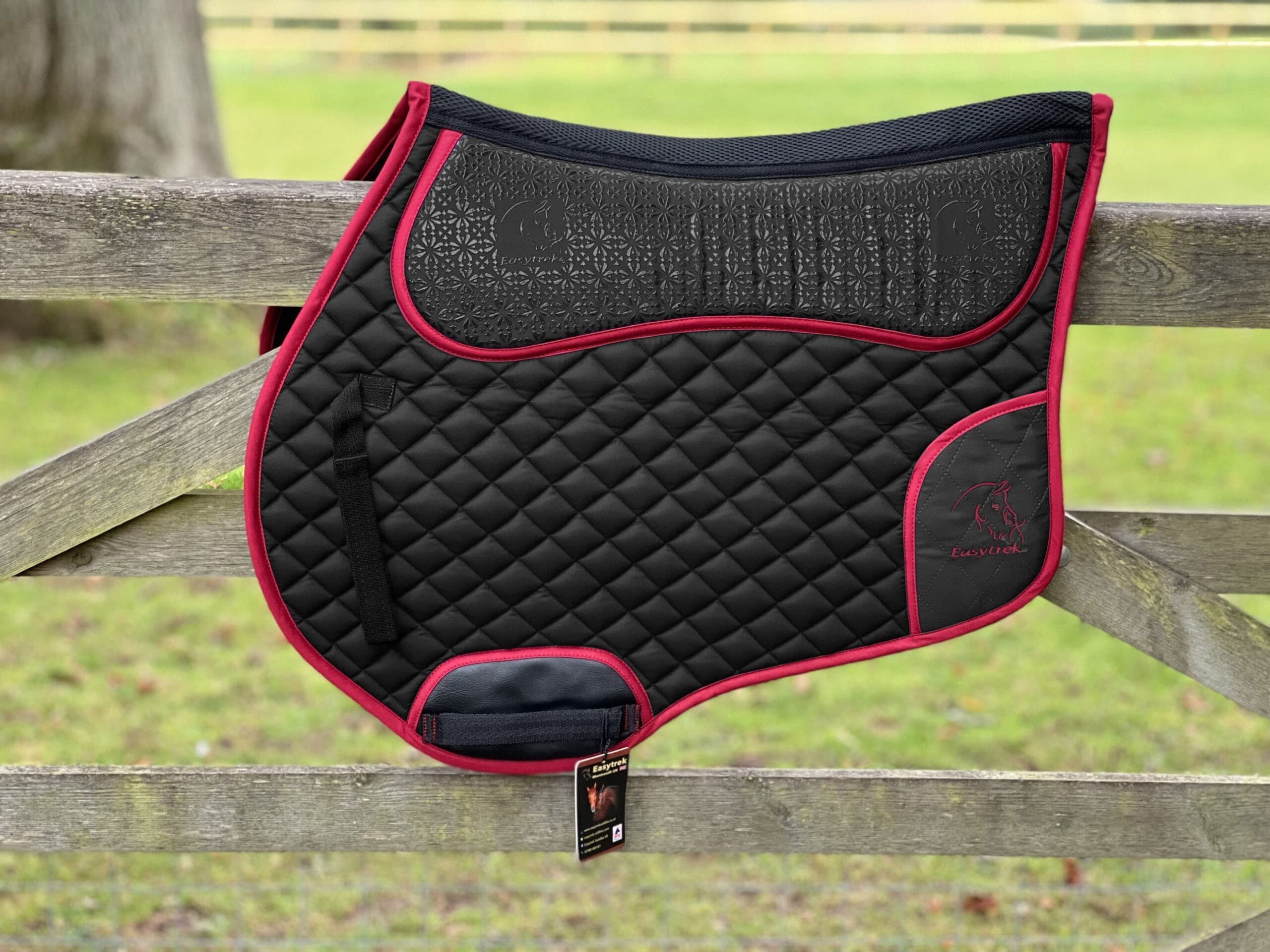
The Easy Trek Anti-Slip Spine Relief Saddle Pad
We’ve banged on for a while there about what a good saddle pad actually needs to do. Here’s the one we make.
The Easy Trek Anti-Slip Spine Relief Saddle Pad was originally designed for our treeless saddles — where the demands on a saddle pad are highest — and turns out to be an excellent everyday pad for treed saddles too. What it gives you:
- Dual-sided silicone anti-slip — grippy panels on both sides of the pad, locking the saddle to the pad and the pad to the horse. This is the bit most other pads get wrong.
- Shock-absorbing spine relief panels — proper built-up channel along the spine, taking pressure off the vertebrae rather than just stitching a fake channel into the fabric.
- Drytex sweat-wicking padding — pulls moisture away from the horse’s back, keeps them cooler and drier during work.
- Genuine soft leather girth protection pad — leather where it touches the girth straps, so it doesn’t fray or wear through.
- Adjustable Velcro girth guides — keep the pad locked into position under the saddle, so it doesn’t shift during work.
- Storage pockets — handy for keys, treats, phone, the bits and bobs you’d otherwise have to carry.
- Modern cut and design — looks the part as well as working hard.
It’s particularly popular with riders running treeless saddles, anyone with a slipping saddle problem, owners of broad-backed cobs and natives, and Total Contact Saddle users.
What riders are saying
“Best saddle pad I have owned and really nice people to deal with.”
“Really impressed with this! Bought it for my Total Contact Saddle and it holds firm and doesn’t slip. Easy to wash & go too!”
“Best saddle pad for treeless saddles, saddles which might slip, or if you need more height through the gullet. I needed it for all three. The quality is fantastic at a very reasonable price.”
“I have two of these already that have both done thousands of miles over six years.”
The “thousands of miles over six years” review is the one that matters most. Cheap pads don’t do that. Quality pads do.
See the Easy Trek Anti-Slip Spine Relief Saddle Pad →
Frequently Asked Questions
Do I really need a saddle pad? Yes — even with a perfectly fitted saddle. A pad protects the leather from sweat, wicks moisture away from the horse’s back, distributes pressure, and keeps the saddle clean. Riding without one is hard on both saddle and horse.
What’s the difference between a saddle pad and a numnah? A numnah is shaped to follow the saddle’s outline; a saddle pad is usually rectangular and extends beyond the saddle. In modern UK usage the words are often used interchangeably.
Will an anti-slip pad fix a slipping saddle? Almost always, yes — provided the saddle pad has silicone on both sides, gripping the horse and the saddle. Single-sided anti-slip pads only solve half the problem.
Are saddle pads suitable for treeless saddles? Some are, most aren’t. Treeless saddles need a pad with proper anti-slip, spine clearance and shock absorption built specifically with treeless use in mind. Generic numnahs often aren’t enough.
Can I use one saddle pad across multiple horses? You can, but it’s not ideal — pads accumulate sweat and dirt from each horse, which can transfer skin issues between them. Better to have a dedicated pad per horse and wash regularly.
How often should I wash my saddle pad? For daily riding, weekly. For occasional riding, after every few uses. Always wash before storing for any length of time — sweat left in fabric breeds bacteria and breaks down fibres.
What size saddle pad do I need? Match it to your saddle size. Most pads come in pony, cob, full and extra-full sizes, or in saddle-seat-size equivalents (15–18″). The pad should extend a couple of inches beyond the saddle on all sides — too small and it doesn’t protect; too large and it bunches.
Got a slipping saddle, a tricky-to-fit horse, or a question about which pad would work best for your setup? Drop us a message — happy to help you work it out before you buy.